
Yacht Broker CRM Software That Actually Fits
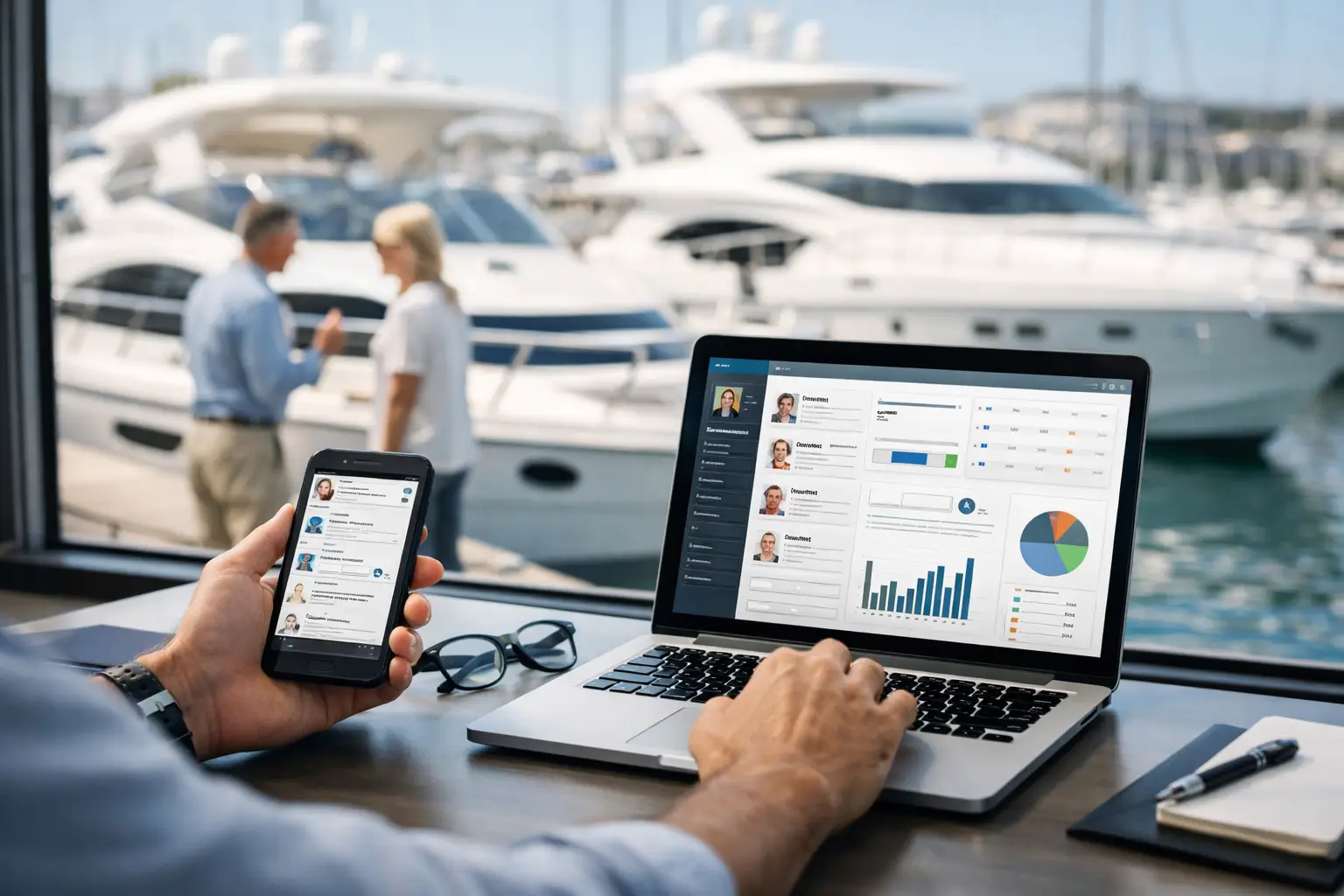
A broker gets a new central listing at 9:12 a.m. By 9:40, the photos are uploaded, specs are adjusted, and the yacht is live on the company website. But two major portals are still outdated, one team member has an older price in their notes, and a serious buyer inquiry is sitting in a separate inbox. That is exactly where yacht broker CRM software either earns its place or becomes just another login.
For yacht sales, generic CRMs are rarely enough. The job is not just managing people. It is managing listings, distribution, co-broker relationships, inquiries, follow-up, and timing across a market where one missed lead or one outdated specification can cost real money. The right system should reduce admin, keep inventory accurate everywhere, and give brokers a faster path from listing to closing.
What yacht broker CRM software should really do
A lot of platforms call themselves CRM software when they are really just contact databases with a pipeline view. That may work in industries where the product does not change much. In yachting, inventory is the business. Specs change. Prices move. Media gets updated. Listings need to appear across multiple channels without forcing your team to re-enter the same vessel data over and over.
That is why yacht broker CRM software has to do more than track conversations. It should connect contacts to vessels, vessels to marketing channels, and inquiries to actual sales activity. If your brokers still copy listing details between systems, your CRM is not fixing the main operational problem.
For most firms, the best setup is not a standalone CRM at all. It is a yachting-specific operating system that combines CRM, listing management, and distribution. That structure matters because it reflects how brokers actually work. They do not sell in separate silos. Their listings, buyers, sellers, and co-broker networks all move together.
Why generic CRM tools break down in yachting
On paper, a broad-market CRM can look attractive. It may offer custom fields, automations, email templates, and pipeline stages. But the minute a brokerage starts pushing listings to multiple portals, handling co-brokerage, or syncing data from a website, the gaps show up fast.
First, there is duplicate entry. A generic CRM may store the vessel as a record, but it usually does not manage listing publication in a meaningful way. So brokers end up updating the CRM, then the website, then partner portals, then internal documents. That is wasted time and a reliable way to create inconsistencies.
Second, there is poor fit for marine data. Yacht listings are not basic product cards. They carry technical specs, builder details, engine information, refit notes, location changes, charter details, and rich media. A platform built for real estate or general sales teams often needs heavy customization just to get close.
Third, there is limited support for broker collaboration. Yachting depends on shared inventory, referral relationships, and controlled cooperation between professionals. If your software is built around one company selling one internal catalog, it misses how the brokerage market actually functions.
That does not mean every specialized platform is automatically better. Some niche tools are strong on inventory but weak on lead management. Others handle contacts well but make distribution cumbersome. The point is simple: if the software does not treat listing data and broker workflows as core functions, it will create friction where you need speed.
The features that matter most in yacht broker CRM software
The strongest platforms solve two problems at once. They centralize data, and they reduce repeated work. That starts with listing import and synchronization.
Listing import and single-entry publishing
If your team can import a boat or yacht listing once from a website, CRM, or API and then publish it across channels, you eliminate one of the biggest admin drains in brokerage. This is where a real efficiency gain happens. One update should push everywhere the listing appears, not just inside your internal system.
For high-volume brokerages, this is not a nice extra. It is the difference between scaling cleanly and adding headcount just to keep data current.
Lead and client management tied to inventory
Contact records matter, but context matters more. A serious inquiry should be tied to the exact vessel, source channel, broker activity, and follow-up history. When that information lives together, brokers can respond faster and managers can see which listings and channels are producing actual opportunities.
A disconnected CRM creates blind spots. You may know who the lead is, but not what listing version they saw, whether the vessel was repriced, or whether another broker already had contact.
Co-brokerage support
Yachting is collaborative. Good software should support secure cooperation rather than forcing every firm into isolated workflows. Shared inventory visibility, controlled data access, and transparent communication can help firms move deals faster without losing control of their client relationships.
There is a balance here. Too much openness creates risk. Too little makes the network less valuable. The best systems are built to support professional collaboration with clear permissions.
Multi-channel distribution
A yacht listing that only lives on one site is underexposed. Serious brokers need broad distribution, but they also need consistency. Specs, pricing, media, and availability should stay aligned across portals and the broker's own website.
This is where a combined MLS and CRM model makes practical sense. It turns distribution into a workflow instead of a separate marketing task.
Mobile access and speed
Brokers are not chained to desks. They are at marinas, boat shows, viewings, and client meetings. If the CRM is slow on mobile or hard to use in the field, adoption drops. That is not a training problem. It is a product problem.
How to evaluate yacht broker CRM software without wasting time
Start with your current bottlenecks, not a feature checklist. If your biggest issue is duplicate listing entry, prioritize distribution and sync. If your team loses leads during handoff, focus on communication tracking and visibility across users. If co-brokerage is central to your model, make collaboration a non-negotiable.
Then look at workflow depth. Ask what happens after a listing is imported. Can it be edited once and updated everywhere? Can incoming leads be assigned automatically? Can your brokers see listing performance and communication history in one place? These are better questions than asking whether the platform has custom dashboards.
Integration also matters, but not in a vague way. Plenty of vendors promise integration and mean a future roadmap. You want to know what works now - website imports, APIs, portal distribution, email capture, and any tools your team already depends on.
Adoption is another real-world filter. A powerful system that your brokers avoid is not powerful. The interface needs to be fast, clear, and built for how marine sales teams already operate. If every task feels like office admin, brokers will revert to spreadsheets, inboxes, and private notes.
The shift toward all-in-one yachting platforms
The market is moving away from stitched-together tools for a reason. Separate systems for CRM, listings, website updates, and distribution create delay. They also create accountability issues because no one knows which system holds the latest version of the truth.
That is why more brokerage firms are looking at all-in-one yacht broker CRM software built specifically for marine sales. The value is not just convenience. It is operational control. When listings, contacts, marketing, and broker collaboration run through one platform, firms can move faster with fewer errors.
This is also where AI starts to matter, but only when it supports actual work. Not every AI feature is useful. Auto-assisted data handling, content support, workflow triggers, and smarter matching can save time. Generic AI branding without workflow impact is just branding.
EasyMLS is part of this shift by treating yachting as its own category rather than forcing marine professionals into software designed for another industry. That distinction matters because yacht brokers do not need a retrofitted sales tool. They need a system built around listing visibility, synchronized updates, co-brokerage, and lead management from day one.
Choosing software that helps you sell, not just organize
The right platform should make your operation feel tighter within the first week. Fewer repeated tasks. Faster listing publication. Better lead follow-up. Clearer visibility across brokers and inventory. If it does not improve those fundamentals, it is not helping the business grow.
There is no perfect system for every brokerage. A boutique firm with a small portfolio may prioritize simplicity. A larger dealership or international brokerage may care more about distribution reach, multilingual capability, and API connectivity. It depends on your volume, market, and team structure. But the baseline is the same: yacht broker CRM software should remove friction from selling yachts.
That is the standard worth using. Not whether the software has the longest feature list, but whether it helps your team list once, publish everywhere, manage every lead in context, and spend more time closing deals than cleaning up data.